

LAS VEGAS · CRATING GUIDE
How Custom Foam Inserts Help Reduce Freight Shipping Damage
Freight handling can expose valuable equipment, electronics, medical devices, industrial components, artwork, and fragile materials to damaging forces. Many shipments are packed in strong boxes or wooden crates, yet they still arrive with cracked housings, broken connectors, bent parts, or cosmetic damage.
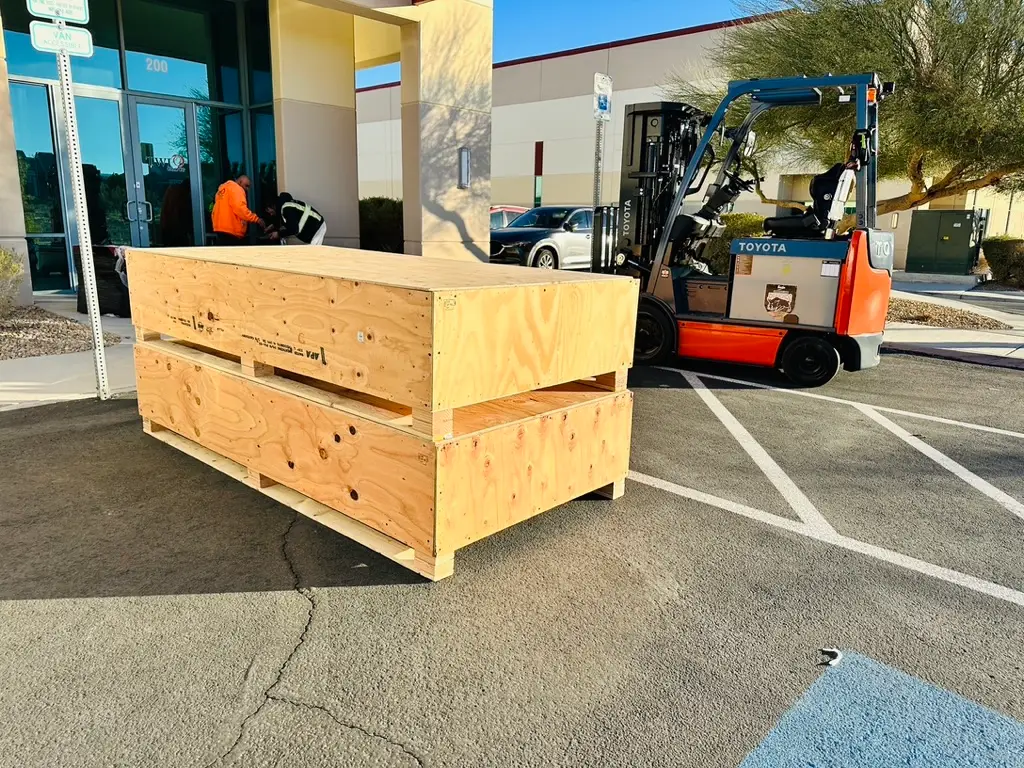
The reason is simple: a strong outer package does not automatically protect the item inside.
This is where custom foam inserts become critical. Properly selected custom foam supports the item and helps manage impact forces. Its shape, material properties, thickness, and loaded support area all affect performance.
For companies shipping from Las Vegas, Henderson, Summerlin, North Las Vegas, and throughout Clark County, custom foam inserts can be part of a packaging system designed to reduce damage risk.
In this guide, we will explain how custom foam inserts work, when they offer advantages over loose packing materials, and how they help reduce damage during LTL, air freight, and ocean shipping.
Why Products Get Damaged Even Inside a Crate
Many businesses assume that once an item is placed inside a wooden crate, it is fully protected. Internal movement is one possible cause of freight damage, alongside impacts, inadequate support, compression, and environmental exposure.
During transportation, shipments are exposed to:
Forklift handling
Trailer vibration
Sudden braking
Impacts from other freight
Terminal transfers
Stacking pressure
Container movement during ocean transit
Even a few millimeters of repeated movement can cause wear, loosen fasteners, crack plastic housings, damage circuit boards, or scratch finished surfaces.
A well-designed insert limits unwanted shifting while allowing the controlled compression needed for cushioning.
What Are Custom Foam Inserts?
Custom foam inserts are engineered foam components designed specifically for a particular item. They are commonly made from polyethylene (PE), polyurethane (PU), cross-linked polyethylene (XLPE), or anti-static foam depending on the application.
Unlike loose bubble wrap or packing peanuts, custom foam is cut to the exact dimensions of the product.
Common applications
Medical equipment
Electronics and servers
Aerospace components
Industrial instruments
Hotel and casino fixtures
Artwork and collectibles
Trade show equipment
Laboratory devices
For businesses in Las Vegas and Henderson, foam inserts are frequently combined with custom wood crates to create a complete protective shipping system.
How Foam Absorbs Impact Energy
The primary job of foam is not simply to cushion the item. It is to manage impact energy.
When a package is dropped or struck, the foam compresses and slows the transfer of force to the product. This increases the stopping distance and reduces the peak shock that reaches the item.
Why this matters
When a fragile device strikes a hard surface, it stops abruptly. Suitable foam compresses under the load, extending that stopping process and reducing peak shock.
Foam should be selected using the item’s weight, supported area, fragility, available cushioning thickness, and expected handling. Density alone does not identify the best material. Foam that is too stiff, too soft, or overloaded may perform poorly. CCI’s safe-shipment guidance explains the importance of matching the cushion to its load.
Preventing Vibration Damage During LTL Shipping
LTL freight can be demanding for sensitive equipment because shipments may travel through multiple terminals and remain on trucks for long distances.
Continuous vibration can cause:
Loose electrical connections
Cracked solder joints
Calibration drift
Surface abrasion
Component fatigue
A foam system may isolate some vibration and amplify other frequencies. Holding an item tightly is not the same as isolating vibration; sensitive equipment may require package testing.
For companies shipping from North Las Vegas to customers across the United States, this is especially important for electronics, medical devices, and precision instruments where damage may not be visible immediately but can appear after installation.
A well-designed foam insert supports the product at engineered contact points rather than squeezing it uniformly from all sides.
Protecting Fragile Corners, Screens, and Connectors
Many products fail at their weakest points, not at their strongest surfaces. Corners, screens, knobs, ports, lenses, and connectors are often the first areas to be damaged during handling.
Custom foam can be designed with:
Recessed cavities for screens
Relief areas for connectors
Corner energy absorbers
Floating suspension zones
Layered foam construction
This targeted layout can keep packing pressure away from vulnerable areas while supporting stronger parts of the item.
For medical equipment shipped from Las Vegas hospitals or laboratories, connector and display protection is often critical because replacement parts may be expensive or difficult to source quickly.
Foam Inserts for Air Freight and Export Shipping
Air freight requires a balance between protection and weight. Excess packaging increases dimensional weight charges, while insufficient protection increases risk.
Custom foam inserts can help balance those requirements when integrated into the overall package.
Benefits for air freight
- Fit the cushioning within practical package dimensions without reducing needed protection.
- Allow access for inspection and provide clear repacking instructions.
- Confirm the finished size and weight with the carrier before assuming a freight saving.
For export shipments, assess any solid wood packaging against destination requirements. For ESD-sensitive electronics, use the manufacturer’s specified packaging system; anti-static foam alone may not provide discharge shielding. Closed-cell foam is not a substitute for a designed moisture barrier.
Custom Foam vs. Loose Packing Materials
Bubble wrap, loose fill, and other stock materials can be suitable for some products. Custom foam is useful when repeatable positioning, defined support points, or protected cavities are needed.
- Positioning: a shaped insert can reduce packing variation.
- Cushioning: either system must be matched to the product’s load and fragility.
- Vibration: evaluate the complete loaded package rather than assuming one material always isolates better.
- Reuse: inspect for compression, tears, contamination, or fit changes before repacking.
Compare performance and labor over the actual shipping cycle. Appearance alone does not establish protection.
The Hidden Savings of Custom Foam Packaging
Compare the cost of custom foam with the item’s damage risks and the expected number of uses.
Damage-related costs that foam helps avoid
Product replacement
Repair labor
Return freight
Installation delays
Customer complaints
Insurance deductibles
Lost revenue
Administrative claim processing
A damaged shipment may incur several of these costs; the financial benefit depends on the shipment and packing design.
For businesses in Henderson, Summerlin, and Las Vegas, custom foam is often treated as a quality-control investment rather than a packaging expense.
Conclusion
Freight damage is rarely caused by a lack of outer packaging alone. In many cases, the real problem is movement, vibration, and uncontrolled impact inside the package.
Properly selected and evaluated foam can help by:
Limiting unwanted shifting
Absorbing shock
Reducing vibration
Protecting weak points
Supporting the overall export packing plan
Supporting reusable packaging systems
Whether you are shipping medical devices from Las Vegas, electronics from Henderson, or industrial equipment from North Las Vegas, custom foam inserts can significantly reduce the risk of damage during LTL, air freight, and ocean shipping.
For high-value shipments, evaluate the cushioning as part of the complete package and confirm any manufacturer or carrier requirements.
Further Reading
PLAN YOUR CRATING
Plan Your Shipment
Share the item’s dimensions, weight, photographs, destination, shipping method, and handling requirements when requesting a quote. Review custom packaging services, custom crating options to discuss the packing approach that fits your shipment.
Request a Crating QuoteMORE CRATING GUIDES



