

Crate sizing
How to Choose the Right Crate Size: A Las Vegas Business Guide
The right crate size starts with the cargo and the protective system around it. A crate must have enough room for supports, cushioning and safe loading, while remaining compatible with the carrier, handling equipment and receiving location.
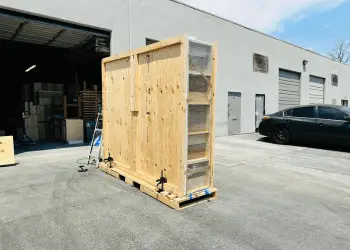
For Las Vegas businesses shipping machinery, artwork or electronics, accurate dimensions are only part of the specification. Weight, fragility, orientation and the route all affect the design. Use the steps below to prepare a useful brief before requesting a custom crate.
Assess Cargo Weight, Fragility and Dimensions
Measure the item's maximum length, width and height in its intended shipping position. Include handles, feet, connectors, frames and other projections. If accessories will be packed separately, list them so their space and protection are considered from the start.
Provide a verified weight rather than a visual estimate. Identify the center of gravity when known and share approved lifting or mounting points. A heavy machine with an offset load needs a different base arrangement from a similarly sized, evenly balanced item.
Describe the vulnerable areas. Delicate finishes, glass, unsupported projections and sensitive instruments may require different clearances or support methods. Manufacturer instructions or conservation guidance should take priority over a generic packing recommendation.
Photographs, drawings and access measurements can help the builder understand the item. Recheck dimensions when anything changes, including removal of a stand, addition of accessories or a different shipping orientation.
Understand Crate Types and Materials
The crate's construction should follow its load and handling requirements. An enclosed crate provides a different level of enclosure from an open frame, while a palletized base can support mechanical handling when designed for the packed load.
Plywood panels, lumber framing, runners, hardware and internal fixtures work together. Plywood is not limited to lightweight items, and hardwood is not automatically the best choice for valuable cargo. Material grade, thickness, fastening and load paths matter more than a broad material label.
A reusable design may include removable panels, accessible fasteners and replaceable internal supports. Discuss how often it will travel, who will repack it and where it will be stored. Reuse still requires inspection for damaged panels, loose joints and worn cushioning.
Export wood-packaging compliance is a separate consideration. Some processed-wood packaging is exempt from ISPM 15, while solid-wood framing or runners may be regulated. Do not choose construction materials on the assumption that every wooden crate has identical treatment requirements.
Allow Space for the Protective System
Internal crate dimensions must accommodate the cargo plus the specified cushioning, supports, barriers and loading clearances. External dimensions also include the walls, base, lid and projecting hardware. Give the carrier the finished external measurements rather than the item's dimensions.
There is no universal rule that every item needs two or three inches of clearance on every side. Cushion type and thickness depend on the item's weight, fragility and expected handling. Some machinery is secured to a base at approved mounting points; a fragile object may require a carefully designed cushioned support system.
For artwork, the Canadian Conservation Institute's packaging guidance explains why cushioning must suit the object and transport hazards. The same practical lesson applies to sizing: allocate space for a defined protective design rather than an arbitrary gap.
Check how the item will be loaded and removed. A close-fitting enclosure can be difficult to use if a support, handhold or tool becomes inaccessible. For several components, plan compartments and a packing sequence so parts cannot strike one another.
Check Shipping and Regulatory Requirements
Ask the carrier about the final packed dimensions, gross weight, handling method and any route-specific limits. Gross weight includes the cargo, crate, packing materials and accessories. Consider truck or container access, forklift capacity, liftgate requirements where relevant, and the receiving route.
Do not assume the outside dimensions are acceptable merely because the crate fits a vehicle's interior. Door openings, loading equipment and maneuvering space may impose tighter limits. Confirm stacking permission explicitly rather than treating a flat lid as evidence that a crate can be stacked.
For international shipments, review applicable wood-packaging requirements alongside the shipment documents. APHIS provides guidance for U.S. exporters using wood packaging. ISPM-15 compliance addresses regulated wood; crate dimensions alone do not establish compliance or determine customs clearance.
Balance Protection, Cost and Efficiency
Excess external volume or weight can affect freight pricing and use valuable loading space. An undersized design can leave insufficient room for protection or make loading unsafe. Ask for a design that balances these factors against the actual carrier quote and route.
For recurring shipments, compare a reusable crate with single-use packaging over the expected number of trips. Include return freight, storage, repairs and repacking labor in the comparison. Savings are project-specific rather than guaranteed.
Before approving fabrication, confirm:
- Cargo dimensions, weight and orientation.
- Internal supports and required protective clearance.
- Finished external dimensions and estimated gross weight.
- Loading, lifting, stacking and opening arrangements.
- Export, carrier and receiving requirements.
- Any future reuse or return-shipping needs.
PLAN YOUR CRATING
Get Help Sizing Your Crate
Send Crates of Las Vegas the cargo measurements, weight, photographs, destination and handling requirements. Include any manufacturer specifications and access limitations so the crate can be planned around the complete shipment.
Contact our team about a custom crate.
Discuss your crateMORE CRATING GUIDES



